RWB does not determine the content of GOOGLE Ads, but does benefit from your click.
Another side of Bob and more!
People disagreeing everywhere you look,
Makes you wanna stop and read a book.
Collected
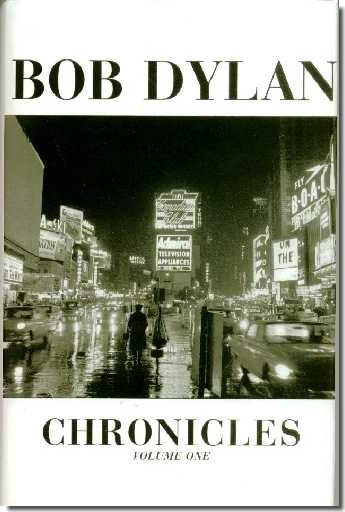
posts relating to Chronicles
and the world's response to it
(in straight chronological order, first to last)
New Morning ... 09/26/2004
Chronicles is excerpted in Newsweek. My own reaction to reading Bob's narrative
is just plain joy and amazement. It is absolutely
direct. From the liner notes to the Jimmie Rodgers
tribute album to the liner notes on World Gone Wrong, it had seemed that Dylan would always add
the turns and twists of poetry to any kind of
writing. But the writing here is just a guy telling
the truth, with the clear desire that the reader
understand precisely what he is saying. Any other
commentary can wait. His book deserves to be read in
full. And the excerpt published so far surely can't
help but make anyone who has spent a lot of time
writing about Dylan feel like stepping back and
reflecting fairly deeply. It is a wonderful thing
that Dylan has arrived at this point and has the
chance and the space to speak for himself.
Kerry Denies Owning Chinese
Assault Rifle ... 09/27/2004 b
... while Bob
Dylan boasts of owning a
"clip-fed Winchester blasting rifle."
Alright. I wasn't going to go to
town on the Newsweek excerpt from Chronicles. I
really wanted to wait until I could read the whole
book. Only thing is, I didn't count on what the rest
of the world was going to do. How can Right
Wing Bob keep silent when everyone else
is hyperventilating over Dylan saying of his hippie
tormentors, "I wanted to set fire to these
people" ... ?
First, I want to reiterate the
prime directive, contained in my mission statement here. It is not my intention to try to
maintain that Dylan agrees with me on all political
questions, or that he can be labeled a
"conservative." He spurns all labels,
and does not participate in partisan politics, and I
respect that about him.
That said, now that this excerpt of
his memoirs has been published, it is not his
conservative-minded fans who are reacting with shock
or horror.
The first thing that needs to be
commented on is that as soon as you get one step away
from Dylan's actual words, the media are still
engaging in their usual distortions.
Since we started talking about
firearms, lets continue on that theme. Any number of
stories, like this in the Herald
Tribune, imply that Dylan
armed himself in his home in Woodstock solely
for the purpose of defending himself against
marauding fans. Their stalking "led him to keep
several guns in his house and stifled his creative
process." So, it equates Dylan with your typical
celebrity who may abhor guns but is forced to carry
one because of death threats and obsessive fans.
That ain't what Dylan writes.
He says, without specifying a
timeline, that "Peter LaFarge, a folksinger
friend of mine, had given me a couple of Colt
single-shot repeater pistols, and I also had a
clip-fed Winchester blasting rifle around ...."
He says he had it around - not that he ran
out and got it when the druggies started knocking on
his door. And consider how he describes these pieces.
He doesn't just call them "guns," like your
average Hollywood liberal would. ("I had to get
a gun - and I hate guns! It's terrible!"). He
characterizes them in a gorgeously colorful and
almost tactile fashion. "Colt single-shot
repeater pistols / clip-fed Winchester blasting
rifle." These terms may or may not be
technically correct, but what's clear is that Dylan
had his own sense of what these firearms were - their
lineage and their design. (Colt and Winchester are
both classic American gun manufacturers, I might add
- no Lugers for Bob!) He knew these pieces, and what
they were mattered to him on some level. All of this
matches perfectly with classic American notions of
the place and purpose of firearms. In rural America
in particular, a firearm is a tool and and a
necessary possession, even for people who are not
being stalked by Californian drop-outs. A farmer
needs a rifle he can depend on, whether for ending
the life of one of his farm animals or defending his
stock from a predator. It's not about wanting to kill
people - as Dylan also says here: "... it was
awful to think about what could be done with those
things." Even in urban America, millions of
people today own guns, not because they look forward
to spilling blood, but because they greatly value
their independence and their ability to defend
themselves if necessary. Dylan had said just a page
earlier in this excerpt,
Being born and raised
in America, the country of freedom and
independence, I had always cherished the values
and ideals of equality and liberty.
As an aside, in a 1981 interview, Dylan was pressed on the subject of gun
control (does Billy Joel have to answer these
questions?). While acknowledging that America
"always has been gun crazy," he also says,
"Guns have been a great part of America's
past," and "I don't think gun control is
making any difference at all. Just makes it harder
for people who need to be protected." (Hey
Wayne! It looks like we've found a successor for
Chuck Heston.)
He is admirably consistent, as
usual. Woodstock 1967, London 1981, and now, in Chronicles,
in 2004. He's the same guy - surprise surprise.
That notion of consistency brings
up another issue. The world's media is reacting like
this is the story of the century, "Bob Dylan
repudiates hippie fans," "unwilling
icon," "fame triggered personal
crisis." To anyone who has been interested in
Dylan's career and read his interviews through the
years, there is certainly nothing shocking in what he
is saying in this excerpt. Those who consider
themselves fans and find themselves shocked by this
either have not been fans for very long or have
selectively tuned out those things they preferred not
to hear. Dylan has gone on the record many times
describing his anguish at being held up as a
spokesman, at having groups of people expecting
something in particular from him. His confrontations
with Weberman and his band of loons in the Village
are well known. His deliberate attempt to put off
these people and make them forget about him by
releasing, for example, "Self Portrait,"
has been common knowledge for decades. Indeed, it was
pretty damned obvious at the time. So the degree to
which surprise and shock is being expressed is a
vivid illustration of just how distorted is the image
of Bob Dylan that the media has been perpetuating,
and just how many individuals have bought into it.
Which reminds me. Bob Dylan grants
a major interview to the Sunday Telegraph about Chronicles.
(Unavailable on their site but posted here.) This fortunate journalist is getting to
speak to Bob directly, as well as refer to Dylan's
own words from his book. But he just can't limit
himself to the facts in front of him - he can't
restrain himself from making his own
characterizations of things about which he clearly
knows next to nothing. Specifically, where he says,
"A year later, Dylan had written his great
anti-war anthem, 'Blowin' In The Wind.'" Et tu,
Mr. Sunday Telegraph? Dylan is on the record too many
times to count saying he doesn't write
"anti-war" songs. At this stage of the game
anyone who's paying attention knows that
"Blowing In The Wind" is a song that asks
timeless questions, but doesn't expect an answer -
and least of all does it expect that war is going to
end. And if you don't expect that war is ever going
to end on this earth, then why would you write an
anti-war song? For more on an anti-war Dylan song
that isn't, see God On Our Side.
There's more to say, but there'll
be more time to say it too, God willing. And the
book isn't even out yet.
Go 'Way From My Window
... 09/28/2004
This, of-course, is nuts. In a story on Chronicles,
this newspaper (Pioneer Press) chooses to talk to
(and hold up as an expert) exactly the kind of fan
Bob fantasized about igniting. In 1972 (when she was
37 years old!) she took a trip from Deerfield,
Illinois to Greenwich Village to hunt down Bob. Who
does she go see to get the skinny on Bob's location? A.J. Weberman, the guy who combed through Dylan's garbage
to find an explanation for his "sell-out,"
and organized street protests in front of his
family's house. Even so, he doesn't willingly give
her Bob's address - she rifles through his papers and
finds it. Then she rings Dylan's doorbell, gets
deflected by Sara, and hangs out across the street
waiting for Dylan to come out. Dylan is gracious to
her when he does, of-course. 32 years later, she is
not so gracious. Speaking of Dylan's choice to play
keyboards instead of guitar in concert these days,
she says:
"I know artists have to
change... I know everything has to change, but he
went off the wall this time ... I'm furious
with him."
And of the last time she saw him in
concert:
"He never picked up the
guitar," she says. "I will be mad
about that for the rest of my life.
That's obscene."
(emphasis added)
This is all pretty obscene alright. This woman
really believes that Dylan owes her something - that
he must meet her expectations and do things in
exactly the way that she prefers. How frightening is
that? It's beyond her grasp that if she doesn't like
what Dylan's doing, she can just choose not to
listen. He must play guitar for her. He
hasn't done enough for her yet.
Is it any wonder that Bob asked Newsweek not to
reveal the location of the hotel where he met their
reporter? It may not be 1968 or 1972 anymore, but
they're still out there.
I have to admit that when I read the excerpt of Chronicles,
with Bob describing being persecuted by
"fans," I felt a pang, kind of like: "I dreamed I was amongst the ones that
put him out to death."
But no. It ain't me babe! Bob can do whatever he
wants. I look forward to being surprised, flummoxed
and knocked off balance. If he should decide to pack
in his music career and start hosting the CBS Evening
News, then fine, he's made more wonderful records
than any human being could ever be expected to make.
I just hope he provides somewhat more balanced
reporting than what we've been getting.
Talking About Chronicles
...09/30/2004
Some interesting tidbits from the online chat with David Gates, who had interviewed Bob
Dylan for Newsweek and offered himself for readers'
questions on MSNBC.com.
The biggest piece of
"news" out of it was a direct explanation
of why Bob is playing keyboards these days -
according to Mr. Gates:
he told me a lot about that.
basically it has to do with his guitar not giving
him quite the fullness of sound he was wanting at
the bottom. (six strings on a guitar, ten fingers
on a piano.) he's thought of hiring a keyboard
player so he doesn't have to do it himself, but
hasn't been able to figure out whomost
keyboard players, he says, like to be soloists,
and he wants a very basic sound. he says he wants
to tweak the sound some, because he's not quite
satisfied with how the guitars and keyboard are
sounding together.
So much, apparently, for theories
about arthritis or carpal tunnel problems. As for the
new songs Bob said he was working on, this additional
delightful detail:
he did say he's written a song
based on melody from a bing crosby song, 'where
the blue of the night meets the gold of the day.'
This was a real trademark song for
Bing, and one he actually has writing credit on too. Right
Wing Bob happens to be a major Bing
Crosby fan, so it is endlessly pleasurable to know
that Dylan is too. He has also alluded to it on other
occasions in the past.
And on a different note, there is
this little grenade, prompted by a question about
what Dylan would be writing about in forthcoming
volumes:
he does have 'blood on the
tracks' stuff and material about
'freewheelin' and his walking off the
ed sullivan show, which, by the way,
he regrets having done. what
else he's written, or might plan to
write, don't know.
Now because Right Wing
Bob is nothing if not fair, I'm going
to grant that since this wasn't a published part of
their interview, it amounts to something only
slightly above hearsay. Nevertheless, how interesting
if Dylan regrets that moment - still held up to this
day by those who would champion his
countercultural/protest persona - when he refused to
play on the Ed Sullivan show because they didn't want
him to sing "Talkin' John Birch
Paranoid Blues."
I wouldn't say it indicates that he is now a member
of the John Birch society, but rather that he may
appreciate that this was a slight song - a topical
song of the kind he avoided putting on his actual
albums - and it was not something to make a
hullabaloo about. Even that Sullivan may have had
good reason not to have someone on his show seeming
to make fun of not just John Birchers, but
anti-communists in general. How nice for history if
there were footage of Bob Dylan on the Ed Sullivan
show performing, say, "Don't Think Twice
It's All Right."
Another little tidbit, prompted by
someone's comment that they are "shocked at Mr.
Dylan's dismissal of the pivotal historic events of
the '60s," though I don't think that's exactly
how Bob has put it. Anyway, Gates includes this in
his reply:
he seems to follow the
newswe shared a little joke about
the apparently forged bush documents.
Priceless.
In case anyone was wondering, and
(bizarrely to me) some were, there's "definitely
no ghostwriter." Simon & Schuster edited and
cut, but "didn't add anything." Anyone who
thinks Bob Dylan would put out an autobio using
someone else's words has got to be in some other
solar system, if you ask me. People have pointed out
seeming clichés or music industry press release type
language in the Chronicles excerpt, like:
"All I'd ever done
was sing songs that were dead straight and
expressed powerful new realities."
People shouldn't forget that Bob
has a penchant for taking cliché and using it in an
off-kilter way to throw the reader/listener and make
them think. Christopher Ricks has written extensively
on this - a nice example is from "I Shall Be Free," - "I see better days and I do
better things," where Bob is playing on the
cliché, "seen better days." Take 10
minutes and you could find a dozen examples yourself.
By using a cliché in an odd way, it also makes the
reader/listener rethink what that phrase means. What
does Bob mean above when he says "powerful new
realities?" I don't know, but I could speculate
... I won't right now. Whether doing these things
with cliché will work in a good way in a book of
prose, and in a memoir, is open to debate. Only a few
people have read the whole book at this point, and
they don't seem to be commenting.
My grubby little hands can't wait.
Addendum: Another nice detail,
this time from the Sunday Telegraph interview, which
is now available in the Chicago Sun-Times, is that before running off to New York
city to become "the conscience of a
generation," the young Bob Dylan seriously
considered "enrolling in the Army and
going to West Point."
Just wait for people to start
saying that Dylan is engaging in revisionist history
and portraying himself incorrectly for some
unfathomable, inscrutable reasons of his own. I'm
just glad to be one of those fans for whom this
self-portrait makes simple, straightforward sense.
"Bob Dylan Is The
Nowhere Man" ...
10/02/2004
I expect there to be more of this -
a lot more. In the popular left wing blog, Daily Kos,
there is this posting, where it is stated that "Bob Dylan is
a total fraud." In what is basically a reaction
to the published excerpt from Chronicles and
accompanying interview in Newsweek, the writer slams
Dylan as "a maladjusted man," "acid
fried dope freak," and further says "Bob
Dylan is not Bob Dylan. He is not even Robert
Zimmerman anymore."
Even the Newsweek reporter is
consigned to hell, for not coming up with the
appropriate questions to ask of a 63 year old giant
of American song, namely, about "politics, 9/11,
religion," and "Bush or Kerry or today's
world of terror politics."
There are a couple of premises
underlying this rant. One, that the writer is someone
who has been deeply impressed by Dylan's songs in the
past (or else why would he care a jot about the
subject?), and two, that the writer has gotten the
distinct feeling that his heretofore idol is not
supplying the answers that he wants to hear - and
that even if the Newsweek reporter had asked all of
these specific political questions, this
"fraud" Dylan would not have said the right
thing - i.e. would not have condemned Bush and
preached against the war we are currently fighting. I
guess it comforts the ranter to dismiss him as some
kind of burnt out shell of the real Bob Dylan -
whoever that may be.
Whether the backlash to Dylan's
straightforward self-expression in Chronicles
(which this writer has still not obtained and read)
will reach the level of the backlash against his open
Christianity back in '79 and the early '80s, and
whether it will have tangible effects (like a
drop-off in concert attendance) is an open question
at this point. I tend to think not - I think that
Dylan is right in thinking that he has largely
escaped the burden of his myth and people's
expectations, and that his audience these days is a
lot closer to accepting him for what he is, and is
happy to hear whatever it is he brings to the stage
each night. At least that's what I hope. But in spots
like Daily Kos and elsewhere, I'm sure there will be
a lot more ranting before it's all through.
Well, I try my best
To be just like I am,
But everybody wants you
To be just like them.
They say sing while you slave and I just get bored.
I ain't gonna work on Maggie's farm no more.
"His version" of
his life ...
10/03/2004
As if to underline what Right
Wing Bob wrote yesterday, here's an example from the British Sunday Times of someone
trying to delegitimize Dylan's memoirs before they've
even been read. After summarizing some of the
information that was published in the Newsweek excerpt (that Bob never wanted to be the voice of a
generation, felt hunted by obsessive followers etc),
the writer expresses his shock:
Holy cow. What will the
63-year-old prince of folk, whose anthems were
adopted by the civil rights movement in the early
1960s, tell us next?
So, the writer ignores the fact
that what Dylan says in the excerpt is perfectly
consistent with his remarks in interviews for the
better part of four decades, and instead wants us to
believe that because particular groups
"adopted" his "anthems," that
this tells us some more accurate truth about Dylan -
as if you draw your conclusions about a songwriter
based on the character of the people who might choose
to sing the songs. It's kind of like saying that Cole
Porter must have been a big lover of spaghetti,
meatballs, Jack Daniels and Ava Gardner, since his
greatest interpreter, Sinatra, enjoyed all of those
things. (Of-course Bob was demonstrably
sympathetic to the civil rights movement, but the
writer here is clearly using that example as a broad
brush to try to say that Dylan enjoyed political
activism generally, and saw himself as writing theme
songs for varied causes.)
So the writer thinks that the
question of the moment is: "... how much further
Dylan is prepared to go in deconstructing
himself." Note, not deconstructing his myth,
which presumably would be the correct result of
telling the straightforward truth, but deconstructing
himself, ending up presumably with something
other than the truth about himself (which this writer
obviously has a better eye for).
He ends his piece with this lovely
expression of dubiousness:
He has promised to set the
record straight in a way that no one could
misinterpret. But who has written the book
Bob Dylan or Robert Zimmerman?
He's almost perfectly echoing the
idiot I quoted yesterday from Daily Kos, in
enunciating both Bob's birth and legal names, as if
this makes some point or other. Whatever that point
may be sure escapes yours truly.
Aside from the parts I've quoted,
this article is not particularly mean or stuffed with
lies and distortions. However, the quoted parts
basically bookend the piece and I believe are
intended to leave the reader thinking that Dylan's
forthcoming memoir is likely to be just one more
"reinvention" in a long line of
self-created myths and images. So, it is a
pre-emptive attack on an unread book that the author
(Dylan) has stated is just his attempt to tell the
truth as he remembers it.
It's also more evidence that there
is great nervousness out there in
left-wing-Bob-Dylan-fan-world in advance of the
publication of this book. While here at RightWingBob.com,
we simply wait with eager and open minds for the gift
that Dylan is providing for us - his fans - and for
history.
I got my dark sunglasses,
I'm carryin' for good luck my black tooth.
Don't ask me nothin' about nothin',
I just might tell you the truth.
Et tu, ISIS ... 10/04/2004b
No official review of Chronicles,
that I know of, has yet been published. No one who
has read the entire book has as yet come out with any
detailed description of it. However, the
pre-publication spin continues. The theme - in case
you haven't gathered it yet - is that nothing that
Dylan says in it is going to be reliable. He has his
own mysterious ulterior motives, and besides, he's
such an incorrigible chameleon (nice parodox there)
that whatever picture he presents will be just one
more illusion. So, his own express statement that,
"When you write a book like this, you gotta tell
the truth, and it can't be misinterpreted," is
simply being shrugged off - even and especially by
those who consider themselves great admirers of the
man and his music.
Take this from the BBC today. The writer of the piece says,
"So-called Dylanologists remain skeptical about
whether the complete truth will finally emerge ...
." Well, complete truth, if you ask me,
is setting the bar a little high, for anyone lacking
in that handy attribute of omniscience. But what
about just allowing that Dylan's intention appears to
be to tell the plain truth about particular events as
he remembers them? The BBC talks to the editor of the
Dylan fan magazine ISIS, and hears the following:
I think he's doing it for his
own benefit ... Those who know Bob Dylan will be
a little bit suspicious. I don't think it's going
to be a completely heartfelt "tell-all"
autobiography ... He has bent the truth right
from the beginning , and what is truth and what
is myth has been blurred - even in his
own mind - with the passing of time.
Now I know that ISIS has been
around a long time and has done a lot of great work,
but what's the idea of characterizing an unread book
in advance in this way, when everyone is either days
or hours away from being able to actually read it?
And isn't stating that Dylan himself has blurred
truth and myth "in his own mind" going a
bit far for someone who is neither Dylan's intimate
friend nor his psychiatrist?
In fairness to the ISIS editor, I'm
sure that the BBC reporter talked to him for some
time and then used a few selected quotes. The agenda
may be more the BBC's - I don't know.
However, I do know that all of this
aspersion-casting on Dylan's intent smells to me like
that political concept of "innoculation."
By saying before the book comes out that you believe
the writer is incapable of reliably telling the
truth, you give yourself a way of later dismissing
anything in the book that you find unpalatable.
"Well, I never thought it was going to be the
truth, you know."
Since the only thing that everyone
has seen at this point is the Newsweek excerpt, I'd really like to know what part of that
strikes anyone knowledgeable as being untrue? Isn't
it just a more intimate angle on events that everyone
knows happened? Isn't that what anyone would expect
of a straightforward memoir?
Within hours, the book is going to
be in this reader's hands, and many others, and all
of this advance spin will be in the past. Still, it's
sure been interesting to Right Wing Bob.
Got it ... 10/04/2004d
I'm on page 55, and I'm taking it
slow, and it is a pure and utter delight, and it's
one more thing: a treasure. After Dylan's 40 year
career of song, no one would have had any right to
expect this of him. Imagine if there were a book like
this by Stephen Foster, or Lorenz Hart? Or Jimmie
Rodgers? Describing their inspirations, their lives,
and the times that carried them? All three of those
songwriters and American originals, now that I think
of it, died in sad circumstances. Dylan has been
given the gift of a kinder fate, it seems. And this
book is a kind and unexpected gift, from him, to
posterity.
Shhhh!... 10/05/2004
I'm going to be reading in any of
my spare time today, rather than posting. There's
lots of stories in the press to accompany the release
of Chronicles - and many of them are
obviously going to include spoilers, so I've often
been glancing at them and clicking away as fast as I
can. However, for a story that includes a fresh
telephone interview with Dylan, check out Edna Gundersen in USA
Today. Not too
much in the way of unheard tidbits from the book,
which is a good thing for those who want to enjoy it
first hand for themselves. (And there is a lot to
enjoy, let me tell ya. It's a total blast ...)

...10/05/2004b
"My
favorite politician was Arizona Senator Barry
Goldwater"
Bob
Dylan, Chronicles, page 283
"There
was no point arguing with Dave (Van Ronk), not
intellectually anyway. I had a primitive way of
looking at things and I liked country fair politics.
My favorite politician was Arizona Senator Barry
Goldwater, who reminded me of Tom Mix, and there
wasn't any way to explain that to anybody. I wasn't
that comfortable with all the psycho polemic
babble." (Tom Mix was a star of silent westerns. Barry Goldwater was of-course the iconic Republican who
wrote "The Conscience Of A Conservative"
and was a formative influence on Ronald Reagan.)
I wasn't going to grab
little things out of the book and trumpet them
mindlessly, but this one is just too much fun.
Someone call Pulitzer ... 10/07/2004
The reviews from the non-Dylan-obsessed critics are
multiplying, and they are certainly skewing heavily
positive, and with good reason. This book is so much
more than yours truly expected. It works on levels
that I didn't remotely anticipate. It's taking time
to settle into me. Someone with as much Dylan-related
baggage as I have is probably least qualified to
provide any snap appreciation of this book. I'm
beginning to realize that Dylan has created something
here that stands aside from his own musical output. I
don't have time to get to grips with it in my own
words in anything other than a glib fashion right
now, so I'll stop right there. Comments from anyone
else who's read it are very welcome. My contacts deep
within the book selling industry also indicate that
it's selling at a feverish clip. So better not delay
- if you don't have it, go out and get it now ...
...10/07/2004b
An especially fine piece on Chronicles
I just read in the U.K. Telegraph (may require free registration). Weirdly, I
can't find the reviewer's name. (Addendum:
It's Neil McCormick - thanks to
Nigel for that info)
The language is pure Dylan,
encompassing the old-world formality of his early
songs (apparently gleaned, in part, from spending
time in the New York Public Library scanning
microfilm of 19th-century newspapers); the dark,
mystical undercurrents of the folk world from
which his music sprang; the biblical flashes of
fire and brimstone rhetoric all held together by
the deadpan humour of hardboiled America, as
if one of Raymond Chandler's private eyes were
re-interpreting the Old Testament.
That's a great line. It closes:
In rock and roll terms, this
book is like discovering the lost diaries of
Shakespeare. It may be the most extraordinarily
intimate autobiography by a 20th-century legend
ever written.
No argument here.
The Winds Of Change Are
Blowing Wild And Free ...
10/11/2004
CBS News Sunday Morning did a
segment yesterday on Bob Dylan. Right
Wing Bob interrupted his devastating
boycott of that entity long enough to take it in.
Though apparently timed to coincide with the release
of Chronicles (they acknowledged that Simon
& Schuster is a sister company of CBS), the
segment didn't deal with that book specifically at
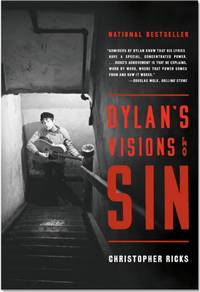
all. It was basically set around the Christopher
Ricks book, "Dylan's Visions Of Sin," and
included on-camera chatting with both Ricks and the
mid-atlantic pop music critic Paul Gambaccini. So it
hovered around the question of whether Dylan is
really a poet (how many times must a man ask a
question, before he realizes the asking has answered
it?). Oddly, though Ricks makes a thoroughly well
studied case with his book, the CBS segment producers
almost undid it all by having some English drama
students solemnly reading aloud some of Dylan's
better known lyrics while staring intensely into the
camera.
If anyone reading this missed it, you didn't miss
much. Reading a chapter of the Ricks book is worth
about 500 of these shows. Most noteworthy to Right
Wing Bob was this: it may have been the
first time a TV show did a cheap summary of Dylan's
career without labeling him the spokesman of
a generation. They almost did, but not quite.
"It's an argument that has raged for
decades: Is Dylan the voice of the baby-boom
generation that without him, wouldn't have a
voice?" (from the website, but the TV
broadcast used a similar line.)
There's the key difference: they used the term,
but they phrased it as a question. That alone is
progress.
Still, I hope if Dylan was watching that he didn't
do any serious damage by biting himself or anything.
See the story in Chronicles on receiving the
honorary degree at Princeton for more on that.
-----------------------------------
Killing Me By Degrees ... 10/11/2004b
Since the Princeton episode came
up, maybe it's a chance to focus on one of the
countless delightful passages in Chronicles. I
don't want to ruin the whole thing, which is worth
reading in full along with the whole book, but to
summarize, it's a moment when Dylan is frustrated at
being labeled by a speaker as "the authentic
expression of the disturbed and concerned conscience
of Young America." He feels he's been taken by
surprise, kind of a victim on stage maybe. This is
1970 and he's particularly upset because he felt he'd
made all kinds of progress at getting away from
titles like that, from the adoration of those
worshipping him for something he was not. Now he
laments with a mix of comedy and tragedy, that
"this kind of thing could set it back a thousand
years." He goes on:
Didn't they know what was
happening? Even the Russian newspaper Pravda had
called me a money-hungry capitalist. Even the
Weathermen, a notorious group who made homemade
bombs in basements to blow up public buildings,
who had taken their name from a line in one of my
songs, had recently changed their name from the
Weathermen to the Weather Underground. I was
losing all kinds of credibility.
Just hilarious stuff.
Jet Pilot ... 10/13/2004
Who'd a thunk? The Village Voice reviews Chronicles and it's a fine review, with no mention of
anti-war protest songs, no gratuitous slams of Bush,
no back biting of Dylan for imaginary back slidings.
Just a perceptive, appreciative review. There are
quite a few of them around of-course, though this one
is better written than most.
So, contrary to some of the
negative pre-publication talk by some fearful and
defensive Dylanites ("it's not going to be the
truth blah blah blah"), it looks like Dylan has
genuinely succeeded, thanks to the sheer strength of
his writing, in blowing away his potential critics.
It's just about impossible for any person with a
fraction of fair-mindedness to read Chronicles
and think that Bob is making it all up, and pursuing
some twisted agenda of his own for re-invention,
though this had been the line some were taking in
advance, as covered in this space back then. Though
there are some vignettes where he's self-evidently
taking license ("I cut the radio off,
crisscrossed the room, pausing for a moment, to turn
on the black and white TV. 'Wagon Train' was
on.") he's clearly doing it to set a scene and
offer a flavor, before going on to describe
experiences of greater import, which are actually
believable memories.
NPR has their radio interview snippet with Bob. Pretty short, and pretty short on
anything new, but, since it's so rare, it's just nice
to hear Bob talking - even giggling. One piece of
news (to me): Dylan says that along with being able
to sail a boat, he can also fly a plane. Add that to
his affinity for firearms and it seems he's a regular
James Bond.
But could Roger Moore sing
"It's Alright Ma, I'm Only Bleeding" in a
convincing fashion? Even Sean Connery? I think not.
Life Is In Mirrors, Death
Disappears ...
10/17/2004
Mike Marqusee reviews Chronicles for the UK Guardian. Marqusee is
author of the recent book, "Chimes Of Freedom,
The Politics Of Bob Dylan's Art," where he takes
a classic leftist view of Dylan's work. His general
conclusion in that book seems to be that Dylan has
written powerful songs that articulately argue left
wing points of view, but, lamentably, the man himself
has never stepped properly up to the plate to defend
the correct causes. Most especially, he indicts what
he sees as Dylan's big cop out vis-a-viz the Vietnam
war. Dylan never spoke out against that war in an
interview or public appearance, despite constant
entreaties, and never wrote a song that mentioned the
war specifically (until 1985's quirky Clean-Cut Kid. ed: Wrong!
see below *)
Marqusee writes, "If public life is an ongoing
test for the artist, then when it came toVietnam,
Dylan failed." His assumption seems to be that
but for some kind of moral cowardice or self-serving
desire to be seen as above the fray, Dylan would
naturally have joined the anti-war movement and
condemned the actions of his government and
countrymen.
In this assumption, Marqusee is
exactly wrong, based on a preponderance of the
evidence. However, analyzing the historical record
with regard to Dylan's place in the Vietnam war /
protest maelstrom will have to wait until I have the
time to deal with it at proper length. For now, I
just find it interesting to see how Marqusee, in the
course of what is overall a positive review, attempts
to make his reading of Chronicles conform to
his overall thesis on Dylan.
He makes a point of mentioning
Dylan's portrait of "blues guitarist and Marxist
intellectual Dave Van Ronk," but fails to point
out that Dylan's commentary on his politics is:
"There was no point in arguing with Dave, not
intellectually anyway ... I wasn't comfortable with
all the psycho polemic babble." He likewise
lauds Dylan's sketch of John Hammond, whom Marqusee
chooses to label as "the veteran leftwinger who
produced Dylan's first albums." However, though
Dylan praises Hammond very highly as a true giant in
terms of his contribution to the world of music, he
does not grapple with his politics at all, except for
a mention of Hammond's ire at having one of his
artists (Pete Seeger) blacklisted. And Marqusee
chooses not to note many of the other personalities
Dylan sketches - how about Ray Gooch? Dylan dwells at
length on his time with Ray and Chloe in their West
Village apartment, and Ray's rather unconventional
view of the Civil War, as well as his mesmerizing and
massive collection of guns. (One of my favorite
moments is Dylan asking him what all that stuff was
for, and Ray's deadpan answer: "Tactical
response.") So, Dylan's portraits of powerful
personalities like Van Ronk and Hammond are not in
themselves a reflection of his agreement with left
wing politics. Quite the opposite, as the statement
above about Van Ronk illustrates.
On the other hand, when Dylan
states that his favorite politician was "Arizona
Senator Barry Goldwater," well ... that's pretty
darned direct.
Never fear - Marqusee is ready.
Pre-emptively, in fact, he observes, regarding
Dylan's musings on the inevitable cycles of history,
"Here he seems to be reading back into his youth
some of the attitudes he struck later on." Ah,
so there we are: Dylan is re-inventing himself,
rewriting history, or, as someone more tactless might
put it: lying.
He says: "The young man who wrote 'Hattie
Carroll', 'With God on Our Side', 'Masters of War'
and 'A Hard Rain's A-Gonna Fall' was a poet of
urgency, and he would have found the fatalism
of the later Dylan far too pat."
Leaving aside Marqusee's apparent belief that those
songs were written to achieve some tangible,
immediate end, rather than as timeless commentaries
on aspects of our human dilemma, what about this
notion of "fatalism of the later Dylan?" He
is perhaps alluding to Dylan's lack of proper
"urgency" with regard to any particular
public causes - the fact that in interviews as well
as in his music he now appears to be looking towards
an eternal, God given peace and justice, rather than
expecting such conditions to prevail here on this
earth. Maybe he means that Dylan writes from the
point of view of someone who sees this life as the
blink of an eye, and sees that there is a bigger
equation with which we have to reconcile ourselves.
Marqusee seems to think that this
"fatalism" was thankfully absent from
Dylan's early work.
Uh, let me see. On Dylan's first and eponymous
album, you can hear this:
Well, in my time of dying don't
want nobody to mourn
All I want for you to do is take my body home
Well, well, well, so I can die easy
... Jesus gonna make up my dying bed.
Then there are the songs,
"Fixin' To Die," and "See That My
Grave Is Kept Clean," and "Gospel
Plow:"
Dig my grave with a bloody
spade,
See that my digger gets well paid,
Keep-a your hand on that plow, hold on,
Oh, Lord, Oh, Lord, Keep-a your hand on that
plow, hold on.
None of these were written by the
20 year old Dylan, of-course, but rather carefully
picked, one would think, as tracks on his first album
and the then crowning achievement of his life. If you
doubt his understanding of these songs at that age,
put on that old LP again and listen to him sing them.
Fatalism? Let me see. The album is
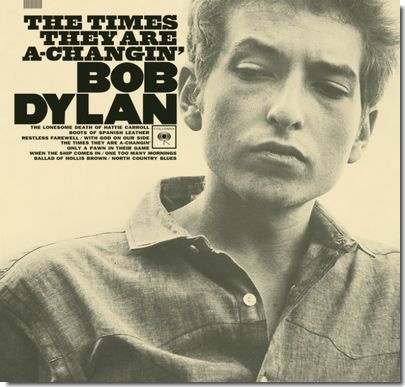
"The Times They Are A-Changin'," the year
1964. This one has some of Mike Marqusee's favorite
songs on it. It also has "The Ballad Of Hollis
Brown." Marqusee also
speaks highly of this song in his book, describing it
as "Dylan's presentation of the self-destruction
of the oppressed ... ." Well, since Dylan was so
young and filled with verve to change the world, I
guess that this song about a destitute farmer who
shoots his family and himself must end with some kind
of call to the barricades - some direct plea to end
all the suffering and to stamp out all poverty once
and for all. No? Well, not exactly.
There's seven people dead
On a South Dakota farm
There's seven people dead
On a South Dakota farm
Somewhere in the distance
There's seven new people born.
Seven people dead and seven new people born? Oh,
well, that's alright then.
OK - Dylan is not being callous and dismissive of
the loss, but he is taking a longer and more profound
view of human tragedy and of life and of death. It is
precisely this that Marqusee accuses Dylan of
"reading back" into his younger self with
this memoir: "He claims that the old songs
taught him there was nothing new on this earth."
Yes, Mike, that's exactly what those songs did teach
him, and it's exactly what a song like "The
Ballad Of Hollis Brown" teaches to those who can
listen to it without leftist kneejerk blinders on.
Fatalism? A bad thing, we're
supposed to believe? In what sense? If there's
anything true that everyone should appreciate about
life, it's that it's bound to be fatal. Being born is
nothing if not a death sentence. Living - it kills ya
every time. The truth however is that it's the
easiest fundamental truth to ignore, and most of us
breeze through the precious moments of our lives
believing ourselves effectively immortal. If we
didn't, it's obvious we'd act differently. I'd
suggest that this is a constant and intense theme of
Dylan's work, and you can draw a straight line from
"In My Time Of Dyin'" on his first album
through, "It's Alright Ma":
For them that think death's
honesty
Won't fall upon them naturally
Life sometimes
Must get lonely.
and on to "Sugar Baby,"
the last track of his most recent album, which ends:
Just as sure as we're living,
just as sure as you're born
Look up, look up - seek your Maker - 'fore
Gabriel blows his horn
And many songs in between (if not all of them,
in some deeper sense).
So, I would say that Marqusee's attempt to show
Dylan "reading back" and reinventing his
younger self completely falls apart on cursory
examination. And the entire broader effort by the
left to co-opt and own the work of Bob Dylan is
thankfully falling apart too, slowly but surely,
aided and abetted by Dylan's great and irrefutable
memoir, and loudly applauded here in the cavernous
offices of RightWingBob.com.
* Wrong! Clean-Cut Kid does not
include the word "Vietnam," though its
reference to a "napalm health-spa" and the
overall story certainly leave the listener convinced
that this is the military action that the
"kid" was involved in. On the other hand,
the 1986 soundtrack song Band Of The Hand DOES mention Vietnam ("for
all of my brothers from Vietnam and my uncles from
World War II") though the song occupies a
different landscape. Likewise, the 1981 unreleased
track Legionnaire's
Disease includes this
verse:
Granddad fought in a
revolutionary war, father in the War of 1812,
Uncle fought in Vietnam
and then he fought a war all by himself,
But whatever it was, it came out of the trees.
Oh, that Legionnaire's disease.
So that would be the FIRST mention
of Vietnam in a published Dylan song.
Finally, one of Dylan's
presumed contributions to the Traveling Wilburys, a
1988 song called Tweeter & The
Monkey Man, includes
these lines:
Tweeter was a boy scout
before she went to Vietnam
And found out the hard way nobody gives a damn
They knew that they found freedom just across the
Jersey Line
So they hopped into a stolen car took Highway 99
So, my original statement that Clean-Cut
Kid is the only Dylan song to mention Vietnam
could hardly be more wrong, in a technical sense, and
I'm indebted to a visitor named Michael M. for
pointing this out. Nevertheless, I think that the
intended point of my sloppily researched statement -
that Clean-Cut Kid is the only Dylan song
that directly deals with the "Vietnam
question" - remains true.
Honest With Me ... 10/26/2004
The NY Times Sunday Book Review of Chronicles
by Tom Carson really called out to be addressed,
although Right Wing Bob has
been trying to make ends meet this week - a
persistently futile effort. The review, to put it
mildly, is snide. Of-course an early and
very positive review of Dylan's book was also in the
NY Times, by Janet Maslin. It's been endlessly
recirculated; here it is in The Arizona Republic.
Though the Sunday book review
supplement has a certain cachet that the daily paper
doesn't, it's probably safe to say that a bad review
there doesn't necessarily sink a book. Just to get
that level of attention is probably welcome to most
publishers, if not writers. And in the case of Chronicles,
it's too late to shut the stable door - it's at
number 3 on the same NY Times' bestseller list, and
has been awarded positive if not rave reviews across
the English speaking world at this point.
However, it's interesting that the
ultimate and essential hit piece on Bob's memoir
should appear in the NY Times. There's a certain
serendipity here - considering their evil hit piece
this week on President Bush - the absurd
"missing explosives in Iraq" story. A
fairly to-the-point angle on that nonsense is here. (Bush is going to win, but big,
sez Right Wing Bob.)
So, as for Tom Carson and Chronicles:
it does not bode well for a serious book review in a
serious publication when it begins by saying that
Dylan's memoir fails to answer the question "So
what was up with the mustache, dude?" He expends
an entire paragraph on that unfunny inanity. From
there he goes on to state that he had not "given
a flying Wallenda about Dylan in years." In the
rest of the review, it must be noted, he then
presents himself as somehow deeply knowledgeable
about the essential facts of Dylan's make-up. The
essential fact - in fact - is that Bob is consumed
with "image tending." And he posits that
"constructing a notional, elusive but
compelling identity to suit the project at hand"
is central to Dylan's work and that this book is just
one more such identity. Here lies the fundamental
flaw in his review (other than his sheer laziness and
ignorance): he fails to see that there is a
consistent identity in the writer and performer we
know as Bob Dylan, and that many listeners can easily
follow the thread from his first recording to his most recent, and find no unresolvable
clashes or contradictions. Changes in musical,
lyrical or singing style do not amount to a disposal
and reinvention of the central actor - i.e. the
creator of the work. And for many of those self-same
listeners, Chronicles represents nothing
more than a straightforward (if also revelatory and
rambunctious) account of the various times and
experiences Dylan has chosen to write about. It isn't
some brand new Bob Dylan, refitted for 2004 - it's
the same Dylan we already knew through his music and
interviews. Those of us who were paying attention, at
least. He's just telling us stories we hadn't yet
heard.
From there onwards, it's really just a matter of
watching exactly how snide and low-to-the-ground
Carson can get. He presumes to tell us that "in
a provincial Middle American town like Eisenhower-era
Hibbing, Minn" (that is so NY Times), Dylan's
Jewishness must have made him a "square
peg," and in not regaling us with stories about
(I guess) alienation and anti-semitic attacks, Dylan
is selectively omitting crucial information. Well -
first of all - Dylan is not feigning to give us a
detailed account of everything he has experienced in
his life. It's 293 pages of fairly large type, after
all. Secondly, how does Carson know what was most
formative in Dylan's life in Hibbing? Why should we
believe that Tom Carson knows better about what is
was like to be a Zimmerman in Hibbing during that
time, and that Dylan is trying to pull the wool over
our eyes and leave out pivotal facts, in the name of
some kind of "image tending?"
Why indeed?
There are many things that Carson presumes to tell
us that he knows better than the writer of the book.
He sneers at the very idea that the 20 year old Bob
Dylan would have any affection for and real knowledge
of American history. How could Bob even dream of
seeing, as he writes in Chronicles, the
ghost of John Wilkes Booth in a Greenwich Village
tavern, fresh as he was from "Hibbing's superb
public schools?" The reference is sarcastic -
Tom Carson presumes to know that the young Robert
Zimmerman had no good history teachers - and that he
never saw an image of John Wilkes Booth in a textbook
- or that if he did it cannot have made any
impression on him. That's a helluva lot of presuming,
unless Tom Carson actually attended school with the
young Robert Zimmerman and his classmates in Hibbing,
Minnesota (in which case I apologize). Even then, he
has chosen to reject the idea that Bob may have had a
particular interest in these matters, and may even
have gathered his knowledge from other sources.
The theme, you see, is that Bob Dylan is lying.
And on and on. He glibly labels the U.S. Civil War
(which Dylan meditates on at some length in Chronicles),
as "the 19th century's ultimate Good/Bad
war," claiming that Dylan's intention is that we
are meant to recall "his own time's coming
storms." There is no such implication in the
book - Carson indeed provides no evidence of one. And
Carson's characterization of the Civil War in that
manner is nothing short of juvenile, tasteless and
ignorant. "The 19th century's ultimate Good/Bad
war." Just a bunch of cocksure ironic bullshit.
And that's just about what the entire review is.
The most sneakily insidious aspect of the whole thing
is that he pretends to actually be praising the book.
Dylan is lying, but doing it in such an entertaining
fashion that we can forgive him. It doesn't matter
whether we're reading truth or lies - nothing matters
except whether the reviewer believes that it meets a
certain standard of hipness or smartness or
timeliness. As he says, "conditional genius is
how pop culture works."
Well, Mr. Carson, you can hang your hat there if
you wish. It doesn't really do it for me. I don't
spend my short and precious time on this earth
deliberately listening to "conditional"
music, or reading "conditional" books and
marvelling at how appropriate to their moment they
are and how short their shelf-life will be, and
laughing off how dishonest they are. If that's how
you choose to approach the work of Bob Dylan,
including this book, then you're just focusing on the
breeze while the train is passing you by. And that's
a real doggone shame.
In Xanadu ...
10/30/2004
This might be the best
written review of Chronicles
yet, in terms of skipping right past the
preconceptions and putting a finger on the real
greatness of the book, as a book. Written by one of
our Australian friends.
With its word-play and
word-magic, its flights of daft numerology and
its detours, its evasiveness on the trivia and
utter candour on the things that matter, this is
an aesthetic memoir to place next to Coleridge's
Biographia Literaria.
I haven't read Coleridge's tome.
However, the full text is online here (and likely many other places) and would no
doubt reward further reading. Considering the
comparison made by the reviewer, dig these opening
sentences of Coleridge's chapter one:
IT has been my lot to have had
my
name introduced both in conversation, and in
print, more frequently than I find it easy to
explain, whether I consider the fewness, unim-
portance, and limited circulation of my writings,
or the retirement and distance, in which I have
lived, both from the literary and political
world.
Most often it has been connected with some
charge, which I could not acknowledge, or
some principle which I had never entertained.
Sounds like he and Bob could have
shared a lot of war stories over cigars, or
something. I'm going to keep reading, and will
definitely put a siren up if I find any references to
this guy:

And
all who heard should see them there,
And all should cry, Beware ! Beware !
His flashing eyes, his floating hair !
Weave a circle round him thrice,
And close your eyes with holy dread,
For he on honey-dew hath fed,
And drunk the milk of Paradise.
More On The Memoir
... 10/31/2004
The Washington Times (neo-con rag
and mouthpiece for Bushitler and his fellow fascists)
has a nice review of Chronicles this morning.
Writers And Critics ...11/21/2004 08:32:07
pm
Back to Bob for a minute. In the NY
Times last Sunday, the following letter to the editor
was published, in reaction to Tom Carson's review in
the Times of Dylan's Chronicles. I already
critiqued his review here for being the snide piece of
irony-worshipping garbage that I believe it to be,
and this letter to the editor from someone with
special knowledge just underlines the fact that
Carson's studied and insistent skepticism with regard
to Dylan's reminiscences is utterly misplaced.
Tom Carson's review of Bob
Dylan's ''Chronicles'' (Oct. 24) punctures a lot
of the mystique, but also reveals some basic
ignorance of the Greenwich Village folk scene. Having
spent the last two years editing the memoir of
Dylan's mentor Dave Van Ronk, I can assure Carson
that both Dylan's romantic primitivism and his
fascination with history were the common coin of
that scene. Dylan certainly would have known at
20 that the Café Bizarre ''used to be Aaron
Burr's livery stable'' -- that is the first thing
anyone who played the club remembers about it. Before
Dylan transformed the folk world into a mass of
self-involved singer-songwriters, it was
populated by amateur historians posing as what
Van Ronk liked to call ''neo-ethnics,'' and they
all treasured both their carefully honed hayseed
accents and their links to previous
self-mythologizers like Walt Whitman. Dylan's
memoir, quirky as it may be, gives a
straightforward sense of that time and place.
Elijah Wald
Cambridge, Mass.
Published: 11 - 14 - 2004 , Late Edition - Final
, Section 7 , Column 1 , Page 4
Thank you, Mr. Wald. And since the
book has now been out about 6 weeks, it's worth
pointing out that for anyone who believes it to be
purposely deceitful, they have a little problem with
a dog that doesn't bark. That is, there has been no
rush of contemporaneous figures - and people Dylan
mentions in his book - coming out and saying,
"Hey, that's not how it happened. I was there, I
know." Though it's likely that a few people are
miffed at their portrayal, or lack of one (Robbie
Robertson only gets mentioned for that dumb question
he asks on the car ride), no one seems to be
seriously questioning Dylan's veracity. Aside from
reviewers like Carson, that is - of which there have
been blessedly few.
And while I'm on the subject,
thanks to visitor Russ for mentioning this, Dylan's recent Q
& A with Rolling Stone,
of which I was completely unaware. It's a nice little
exchange. Here's something he says about Chronicles:
With the book, what I try and
do is put a feeling across. It's not the kind of
book where it's a short life and a merry one.
It's more abstract, drawn out over long periods
of time. I worked the book, if you want to call
it that, in patterns. I portray life as a game of
chance.
Bang on, as it should be coming
from the author. But the phrase "Simple Twist Of
Fate" occurred to me a great deal while reading
the memoir. He's highly cognizant of the moments when
his life could have gone one way or another, and so
the book is filled both with a sense of chance and, I
think also, the implicit sense of an unseen hand.
More from the telephone Q & A:
What's the last song
you'd like to hear before you die?
How 'bout "Rock of
Ages"?
I heard you've written
songs for a new album.
I have a bunch of them. I do.
When will you crank 'em
out?
Maybe in the beginning of the
year. I'm not sure where and when.
Can you tell me about
them?
No, I couldn't explain them to
you. After you listen to them, call me back. It's
difficult to paraphrase them or tell you what
kind of style they're in. You won't be surprised.
Why not?
The musical structure you're
used to hearing -- it might be rearranged a bit.
The songs themselves will speak to you.
I love that - when he says about
his next album, "You won't be surprised."
Anyone else would say exactly the opposite, "Oh,
just wait, it's gonna be something different for me,
something you haven't heard before." And of all
artists, Dylan is one who could claim to consistently
surprise. What the heck do you call Nashville
Skyline, Slow Train Coming, Highway 61, Time Out Of
Mind? Some of those, and others, were more
earthquakes than mere surprises. Yet he can
laconically say, hey, I can't describe them, but you
won't be surprised. Hilarious, and true on some level
Dylan's brain operates on.
What a gift it is that he's still
with us and making music, and grown adults can await
his next album with the giddy anticipation of fifteen
year olds.
And with Dubya kicking ass in the White House and
beyond!
It frightens me, the awful truth
of how sweet life can be
The Top Of The End ...12/30/2004 09:19:11 am
Nat Hentoff has this piece on Chronicles today. Another
contemporary from those early years who does not take
issue with the truth of any of the reminiscences in
the book, although he acknowledges learning things
that he did not know about the young Dylan at the
time. Also has some first hand details about how that
slam blast interview for Playboy came about.
Almost 3 months after its release,
with Chronicles resting near the top of the
bestseller lists, and on almost everyone's list of
the best books of the year, it's nice to step back
and appreciate the breadth of Dylan's achievement.
Once again, he defied any and all predictions and
created something both deeply entertaining and
enduring, and in a style that was completely
unexpected. It's what he's done again and again with
his music, but who'd have thunk he'd do it in this
form? As much of a fan as I am, I never would have
expected his book to basically sweep the world the
way it has. Someone like me would have been intrigued
by it if the pages contained a series of black
splotches interspersed with incoherent limericks -
but this book has reached out and found its own
audience. It could easily have been different
perhaps. If a couple of prominent bad reviews had set
the tone, and a few people with an agenda had
succeeded in portraying the work as dishonest and
unworthy of attention, then maybe it wouldn't be at
the top of all these year end lists after all, but in
the remainder bins. Simple twists of fate can decide
such things. But even if that had happened, long
after the noise had quieted, his book would still
stand as the unique portrait of an American artist
that it is. And it will contribute more to
posterity's understanding of his life and work than a
dozen books by the likes of Sounes or Marqusee.
Original text copyright ©
2004, 2005 by RightWingBob.com
Quotes from the works of others are linked to their
source or are as otherwise attributed, and are used
in accordance with Fair Use guidelines. Contact:
rightwingbob(at)gmail.com